

Deel vs Remote (September 2026): an independent comparison
Updated · 8 min · by Nick Schäfer- Verdict: Deel fits teams hiring in many countries at once, including hires who need work permits. Remote fits teams that want every EOR employee on an entity the provider owns, at a higher list price of $699.
- Where Deel leads: Wider reach (own entities and payroll engine in more than 130 countries, hiring in 150+), work permits in 75 countries, and $599 EOR pricing on month-to-month terms.
- Where Remote leads: Entities it says it owns 100 percent, lower contractor and PEO list prices, uncapped indemnity on Contractor of Record, and Remote MCP for your own AI tools.
- The number that decides: $100 per employee per month: the gap between Remote's EOR list price ($699) and Deel's ($599), as of September 26, 2026. Remote's pricing page no longer shows a cheaper annual rate.
- Check before choosing: Check each target country: Remote lists EOR in 90+ countries and Deel more, and salaries, employer contributions and benefits come on top of either fee.
Deel and Remote are employer of record (EOR) providers: they employ people on your behalf in countries where you have no legal entity, run their payroll and handle local contracts, taxes and benefits. Both also sell contractor management and payroll for your own entities, so they end up on the same shortlist for companies with a distributed team.
We compared both on September 24, 2026, using each vendor's pricing, product, security and trust pages, press coverage and our own directory data. ai-toolfinder is independent: neither Deel nor Remote pays us, and we earn nothing from your choice.
Deel or Remote: the verdict
Pick Deel if you hire in many countries at once, need visa or work permit support, or prefer month-to-month billing at $599 per EOR employee.
Pick Remote if you want every EOR employee on an entity the provider owns, want cheaper contractor management or Contractor of Record with uncapped indemnity, or want your AI tools to query workforce data through Remote MCP.
Deel vs Remote: comparison table
| Deel | Remote | |
|---|---|---|
| Best for | Hiring across many countries, including relocations | Hiring through fully owned entities in 90+ countries |
| EOR price (September 2026) | $599 per employee per month, month to month | $699 per employee per month |
| Contractor management | $49 per contractor per month | $29 per contractor per month; Plus plan $99 |
| Contractor of Record | $325 per contractor per month | From $325, with uncapped indemnity |
| Payroll for your own entities | No price on the pricing page | $29 per employee per month plus fees |
| US PEO | $125 per employee per month | From $99 per employee per month |
| EOR reach | Own entities and payroll engine in 130+ countries | 90+ countries, 100 percent owned entities |
| Onboarding claim | As little as 1 day | 2-day average |
| AI inside the product | Deel AI assistant, free with every product | Mobile AI summaries for approvals |
| Link to outside AI tools | Deel app in ChatGPT (per Deel) | Remote MCP for ChatGPT, Claude, Cursor |
| Data hosting | AWS, primary Ireland, recovery site in France | AWS; no region named on its security page |
| Certifications | ISO 27001, 27701, 42001; SOC 1, SOC 2, SOC 3; CSA STAR Level 1 | ISO 27001; SOC 2 Type 2; CSA STAR Level 1 |
Compare all fields side by side, including certifications and hosting →
Deel vs Remote: what it costs per year
List prices according to the vendors, excluding VAT, setup fees, add-on modules and discounts. Currencies are not converted.
What Deel and Remote look like
Pricing: both publish, and billing terms decide the EOR gap
As of September 26, 2026, Deel lists employer of record at $599 per employee per month, billed month to month without a long-term contract. Remote lists $699 per employee per month; its pricing page no longer shows a lower annual rate. Remote says it charges no platform, onboarding or setup fees for EOR, contractor management or HR management.
Below EOR the lists diverge. Remote is cheaper for contractor management ($29 against Deel's $49 per contractor) and for a US PEO (from $99 against $125). Both start Contractor of Record at $325 per contractor, and Remote adds uncapped indemnity against misclassification, tax and penalty risks. Remote's payroll for your own entities costs $29 per employee per month plus an implementation fee and a recurring payroll delivery fee; Deel's pricing page shows no payroll price.
HR software is priced differently too. Deel HR starts at $5 per employee per month for the Core plan, while Remote includes its HR Core with its employment and payroll products. Remote bills in 12 currencies, including USD, EUR, GBP, CHF and JPY. The list prices are platform fees, so ask both vendors for a full cost estimate per country.
AI: Deel bundles an assistant, Remote opens its data to your AI tools
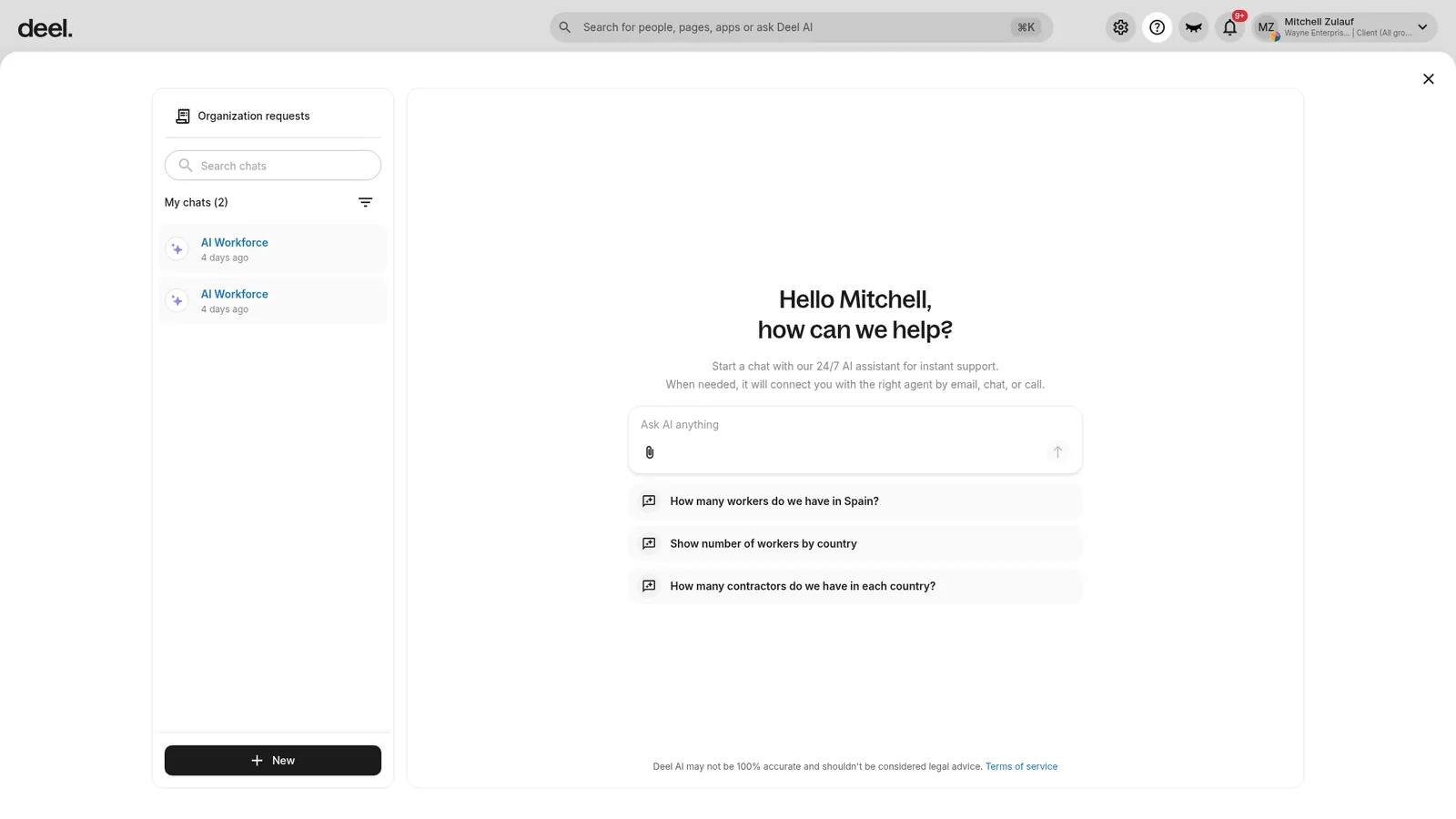
Deel AI is free and included with all Deel products. It answers HR and legal questions from Deel's expert-written Knowledge Hub, uses OpenAI's model for general knowledge and works in Slack; Deel states that conversations and organization data are never shared with any learning models. In March 2026 Deel announced AI Workforce, a set of agents for hiring, onboarding, payroll anomaly checks and time-off requests, without release dates per agent, and said it was the first B2B HR and payroll app in ChatGPT.
Remote goes the other way. Remote MCP lets ChatGPT, Claude, Cursor or any MCP-compatible client work with data on employees, contracts, payroll, expenses, headcount, time off and compliance, with exactly the permissions the user has in Remote, and Remote states that workforce data is not used to train any AI provider's models. Inside the product, mobile AI summaries (added in February 2026) pull the details behind time-off and expense requests into one view, and Contractor of Record includes AI-powered tools and a classification questionnaire against misclassification.
Both now reach into outside AI tools: Deel through its app in ChatGPT, Remote through an MCP server that any MCP-compatible client can use. Teams that work in Claude or build their own agents get the more open route from Remote; teams without their own AI tools get more from Deel's built-in assistant.
Where the products diverge: country count against entity ownership
Deel says it runs its own entities and payroll engine in more than 130 countries and supports hiring in more than 150. Remote lists EOR in more than 90 countries and says it owns and operates 100 percent of its entities, with no handoffs to third parties. For each country you need, ask who the legal employer is and who runs payroll there.
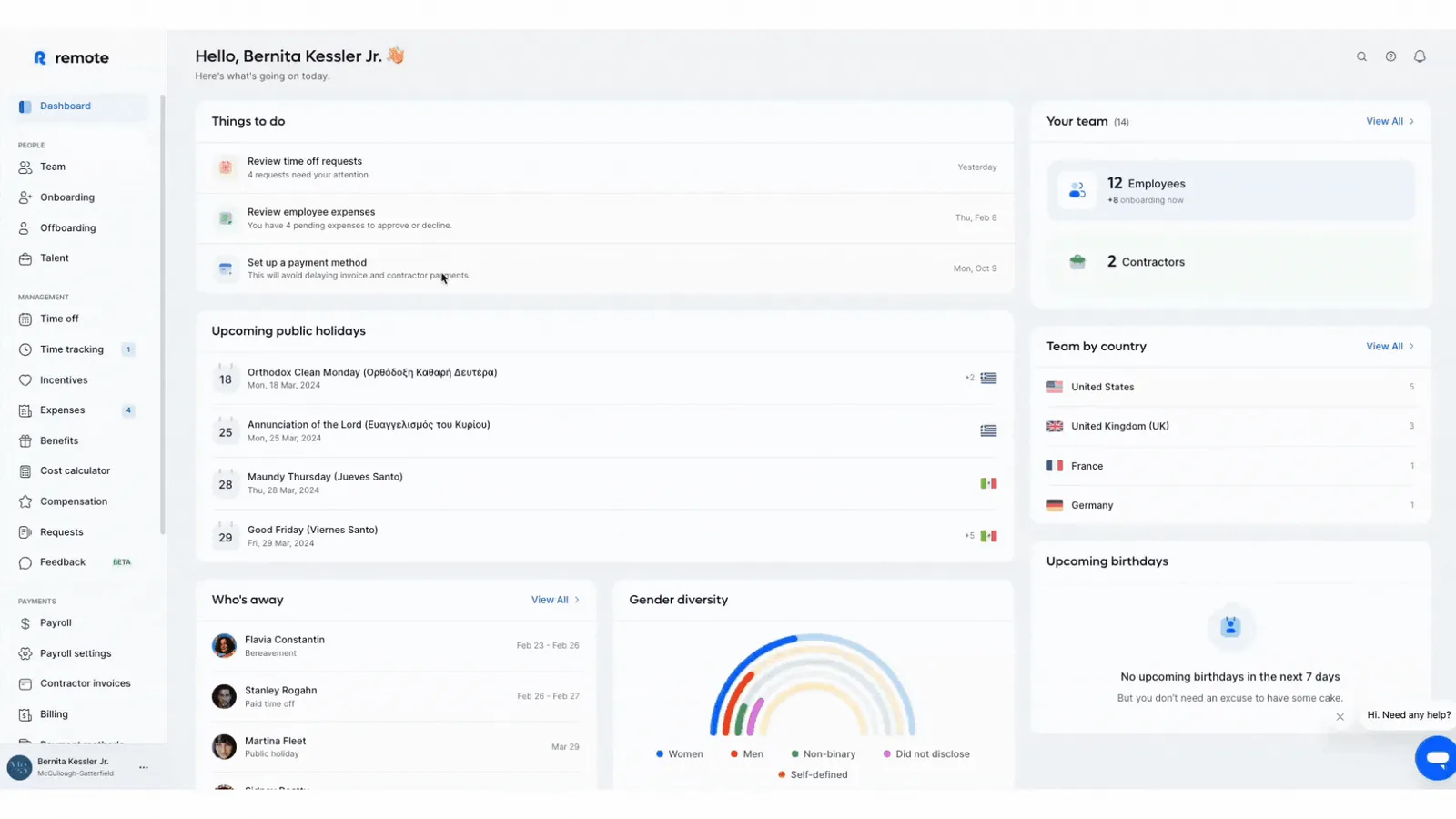
Deel adds relocation: Deel Mobility supports work permits in 75 countries and business visas in 102, with local experts in more than 100 countries. Remote adds Remote IP Guard for protecting company intellectual property in every country and Compliance Watchtower, which monitors legal changes across its EOR countries.
Scale differs as well. TechCrunch reported in October 2025 that Deel had passed $1 billion in annual recurring revenue with more than 35,000 customers, and Deel's site now says 40,000+. Remote passed $300 million in annual recurring revenue by May 2026 and serves tens of thousands of companies, according to TechCrunch. Remote also powers the employer of record service inside BambooHR, which we cover in BambooHR vs HiBob.
Country fit and compliance: both are global, their strongest markets differ
Our directory lists Deel as strong in the United States, the UK, Canada, Germany, Australia and South Africa, and Remote's strongest single market as the United States. Deel's own data for 2024 shows its customers are most often based in the US, the UK, Canada, Germany and Australia, and hire most often in the US, the Philippines, Argentina, India and the UK. Both sit among the global employment providers in our directory, a small group of 9 tools.
In the EU, the AI Act counts AI used in employment and worker management, such as CV sorting for recruitment, as high risk, with obligations applying from December 2, 2027. In the UK, the Data (Use and Access) Act 2025 requires safeguards, including human intervention and the right to contest, for significant decisions based solely on automated processing, in full force since February 5, 2026.
For US roles, New York City's Local Law 144 requires an independent bias audit within the past year, a published summary and notices before an automated tool substantially assists hiring or promotion decisions, which matters if you use Deel's AI screening in Find Talent for New York candidates. Since January 1, 2026, Ontario employers with 25 or more staff have had to disclose AI screening in public job postings. For a US all-in-one alternative to Deel, see Deel vs Rippling.
Who should pick Deel and who Remote
- You need EOR in many countries at once and want the wider published coverage of own entities in 130+ countries.
- Your hires need work permits or business visas.
- You want the lower EOR list price ($599 against $699) on month-to-month terms.
- You want an AI assistant for HR and legal questions included at no extra cost, also in Slack.
- You employ people in South Africa, where Deel runs local payroll through PaySpace.
- You want every EOR employee on an entity the provider owns and operates itself.
- You value fully owned entities and no platform or setup fees more than the $100 difference in the EOR list price.
- You work with many contractors and want the $29 contractor management fee or Contractor of Record with uncapped indemnity.
- Your team uses Claude, ChatGPT or Cursor and wants permissioned access to workforce data through MCP.
- You want to be billed in EUR, GBP, CHF or 9 other currencies.
Deel vs Remote: frequently asked questions
Is Deel cheaper than Remote?
It depends on the product. For EOR, Deel lists $599 per employee per month on month-to-month terms, while Remote lists $699 (as of September 26, 2026). For contractor management and a US PEO, Remote's list prices are lower.
Does Remote really own all its entities?
Remote says it owns and operates 100 percent of its EOR entities with no handoffs to third parties, across more than 90 countries. Deel says it runs its own entities and payroll engine in more than 130 countries. Ask either vendor to confirm the model for each country you need.
Which one has better AI features?
They take different routes. Deel AI is an included assistant for HR and legal questions, and Deel has announced AI agents without release dates per agent. Remote focuses on Remote MCP, which gives your own AI tools permissioned access to workforce data, plus AI summaries for approvals.
Where do Deel and Remote host data?
Deel states its platform runs on AWS with primary operations in Ireland and a disaster recovery site in France. Remote states it runs on AWS but names no region on its security page, so EU buyers should ask for the region in the data processing agreement.
The bottom line
Start with your country list. Where both cover a country, weigh Remote's fully owned entities against Deel's lower $599 EOR list price; where your list includes relocations or countries outside Remote's 90+, Deel is the safer first call. Get a per-country cost estimate from both before signing.
Sources
- Deel, Pricing (as of September 2026)
- Deel, Employer of Record
- Deel, Homepage figures
- Deel, Deel HR
- Deel, Deel AI
- Deel, The Big Deel 2026 recap (March 20, 2026)
- Deel, Mobility
- Deel, Security
- Deel, Trust Center
- Deel, Global Hiring Report
- Deel, Deel is acquiring PaySpace
- TechCrunch, Deel hits $17.3B valuation after raising $300M (October 16, 2025)
- Remote, Pricing (as of September 2026)
- Remote, Employer of Record
- Remote, Contractor of Record
- Remote, Remote MCP
- Remote, New features, February 2026 (February 23, 2026)
- Remote, Security and compliance
- Remote, Trust Center
- TechCrunch, Payroll startup Remote says it grew revenue 50% per employee without adding headcount (May 27, 2026)
- BambooHR, Global Employment (EOR powered by Remote)
- European Commission, AI Act regulatory framework
- UK Data (Use and Access) Act 2025, section 80, legislation.gov.uk
- NYC Department of Consumer and Worker Protection, Automated employment decision tools
- NYC Department of Consumer and Worker Protection, AEDT frequently asked questions
- Hicks Morley, Ontario job posting requirements from January 1, 2026
Independent comparison: neither vendor paid for it or reviewed it before publication. How we review